
Knowledge Centre / Growing Guide
How To Grow Shiitake Mushrooms On Logs
A practical production guide to colonization, browning, fruiting temperature, humidity and flush management for commercial shiitake cultivation logs.
Author: Pen Tsao Ching Editorial Team · Published: November 10, 2026
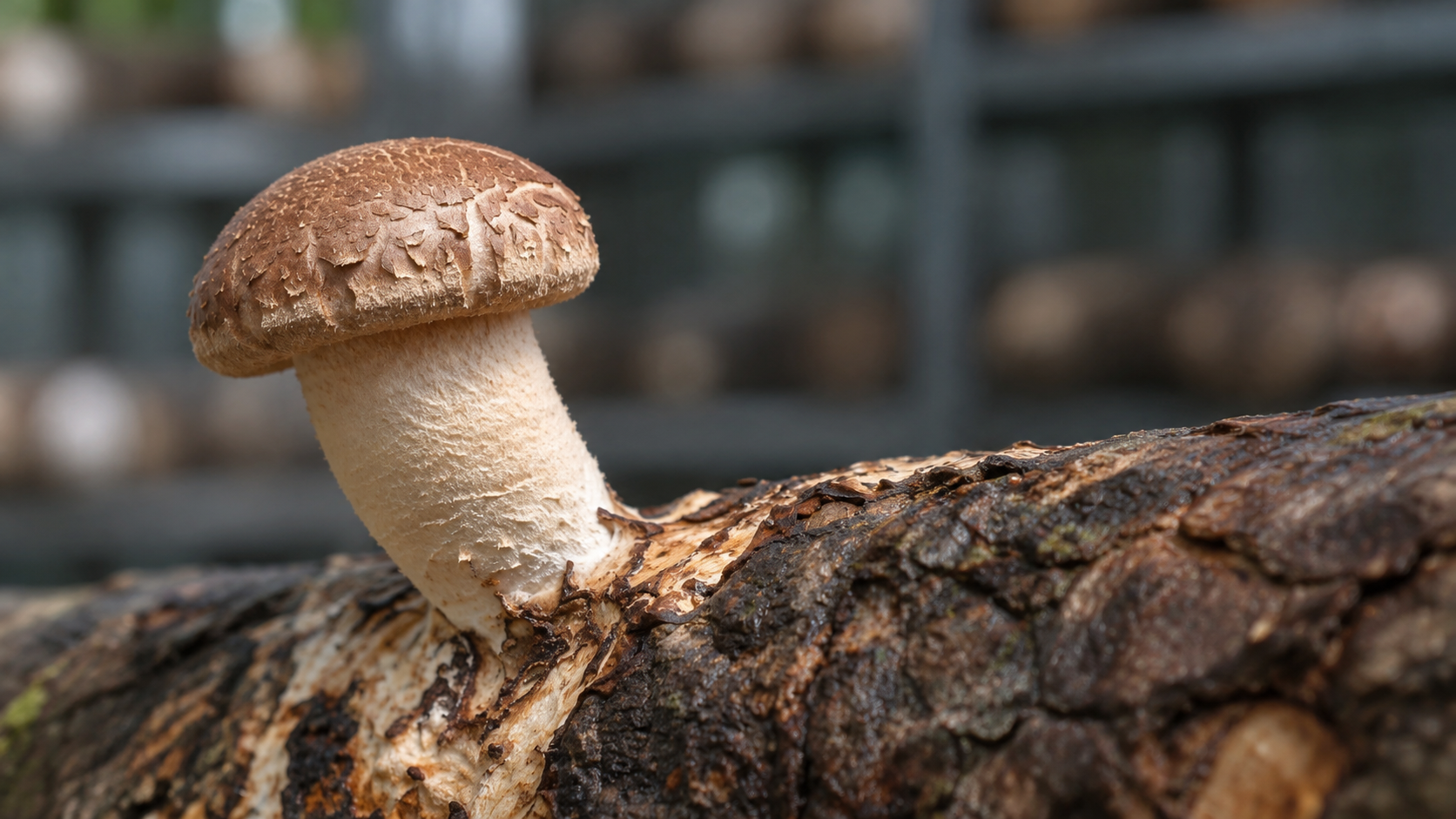
Sawdust cultivation logs are one of the most practical choices for large-scale shiitake production. The method has a mature workflow that lets growers coordinate inoculation, incubation, browning, fruiting and harvest with repeatable production records.
Shiitake log cultivation is a practical route for commercial growers who need a repeatable substrate, clear environmental controls and predictable flush scheduling. Explore our mushroom block solutions for production planning and substrate options.
1. Mycelial colonization 60 to 80 days
During colonization, shiitake mycelium grows through the interior of the log. After inoculation, the culture gradually occupies the sawdust substrate, changing the original wood-colour material to a dense white network. Mycelium spreads from each inoculation point into the surrounding substrate until the entire bag is colonized.
Growth speed is closely related to inoculation-point count and environmental control. Three to four inoculation points are commonly used in a production bag. A temperature of 22 to 25°C and relative humidity of 60 to 70% can support faster colonization, sometimes shortening the cycle toward 60 days when the strain and substrate are well matched.
2. Browning and maturation about 15 days
After the main colonization period, mycelial expansion slows. This is not a skipped stage: it is the maturation period that prepares the log for fruiting. Over roughly 15 to 20 days, the white surface changes to a brown-yellow colour and develops a thin protective skin that helps shield the mature mycelium from contamination.
Keep the temperature around 20 to 24°C and below 28°C. Relative humidity should stay below 70% to reduce the risk of soft, damaged or rotten logs before fruiting.
3. Fruiting management about three months
Commercial shiitake logs are designed to produce a high first flush and then a predictable sequence of later flushes. The first flush is usually the largest, with a representative log producing around 400 g under suitable conditions. The second flush may reach roughly half of the first, followed by a gradual decline.
Many farms harvest the first three flushes before moving in a new production batch. Some operations harvest only two flushes when labour, space and cost control are the priority. After each flush, allow the log to rest for 15 to 20 days while it is rehydrated and the mycelium recovers before the next fruiting cycle.
A practical fruiting temperature range is 8 to 18°C. If temperatures remain above 20°C, fruiting can decrease and the mushrooms may become misshapen or open their caps too quickly.
Maintain air relative humidity at approximately 85 to 95% in the fruiting room. Pins and developing fruit bodies require substantial moisture, so mist the floor and surrounding air to maintain humidity. Avoid spraying young pins directly with excessive water, which can cause pin death and soft rot.
Operational checklist
- Record strain, inoculation date, bag formula and inoculation-point count.
- Keep colonization areas clean, shaded and well ventilated without over-drying the substrate.
- Confirm browning before moving logs into the fruiting environment.
- Track each flush, rest period, water input and harvest weight.
- Adjust temperature, humidity and airflow together rather than treating one setting as universal.
References
- Cornell Small Farms Seven Stages of Cultivation — incubation, browning, initiation and flush management.
- Cornell Small Farms Spawn Run and Incubation — moisture, shade, airflow and contamination management.
- Cornell and University of Vermont Best Management Practices for Log-Based Shiitake Cultivation — log inoculation and commercial production guidance.
- Cornell Small Farms Outdoor vs Indoor Specialty Mushroom Systems — fruiting environment and rest between flushes.
Leave a Reply