
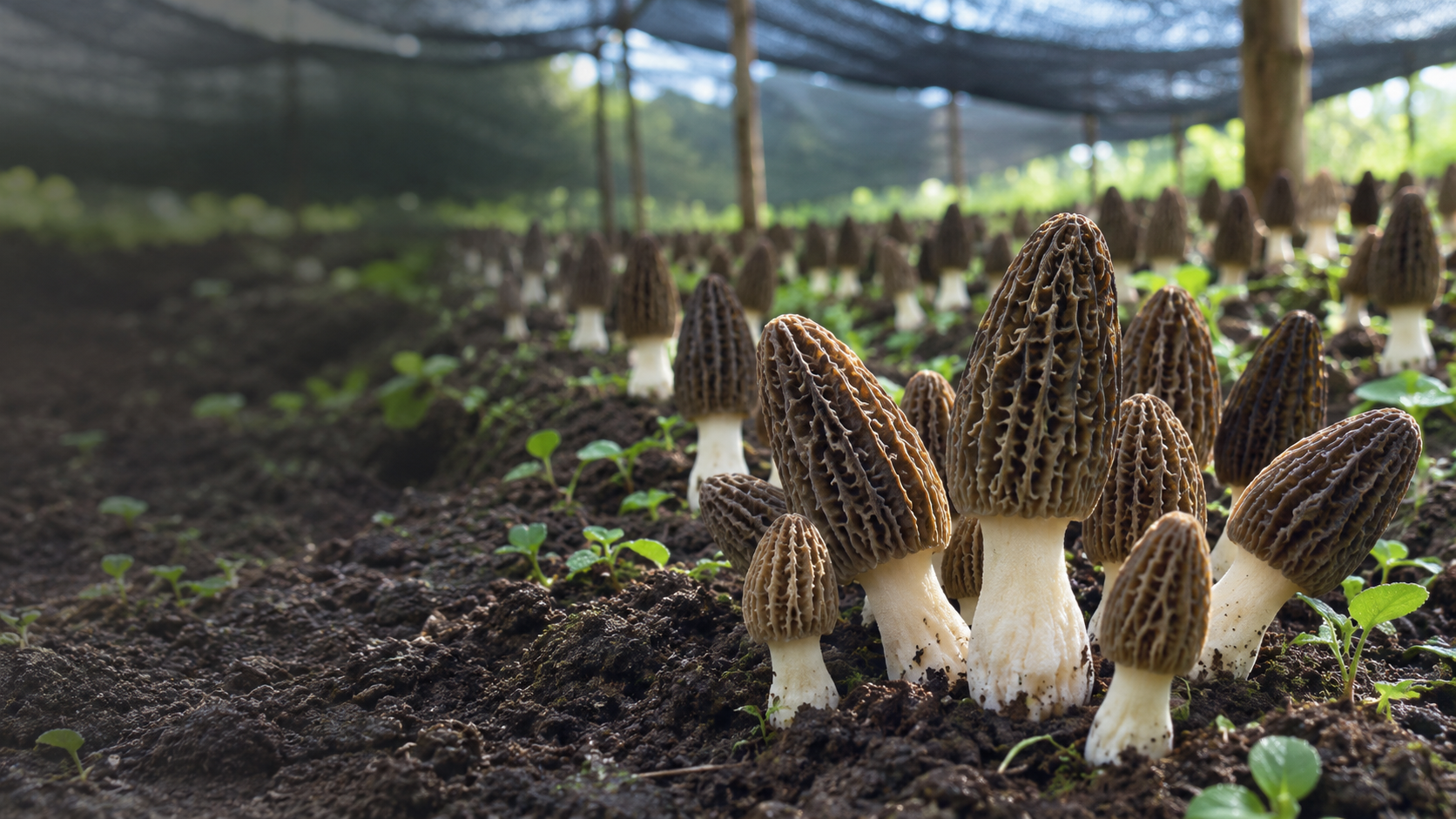
How to Grow Morel Mushrooms
A field protocol for substrate preparation, soil incorporation, fruiting control and harvest in bag-free Morchella production.
Morel mushroom growth and development require suitable soil and environmental conditions. In production, the factors should be coordinated according to the requirements of different growth stages so that high and stable yields can be achieved.
Growth and development conditions
Soil
Soil is the foundation for morel mycelial growth and fruiting-body development, and soil quality directly affects morel yield. Morels can grow in clay soil, sandy soil and loam. Soil with low clay content, good permeability, and a neutral or weakly alkaline pH of 6.5–8.0 is usually selected. Morels do not require a high level of soil organic matter, but they do require certain mineral nutrients and trace elements such as phosphorus and potassium.
Temperature
Temperature promotes the formation of fruiting bodies, but temperatures below or above the growth range are unfavorable for normal fruiting-body development. At excessively high temperatures, fruiting bodies have thin flesh, long stems, short caps and a yellow color, resulting in low commercial value. At excessively low temperatures, fruiting bodies grow slowly and become thick-fleshed and dark. Controlling and maintaining a suitable temperature is the key to improving morel yield and quality.
Humidity
During the mycelial growth stage, the relative humidity of the cultivation-room air should be 40%–50%. High relative humidity makes it easy for contaminating organisms to multiply. During fruiting-body formation, the relative humidity should be 85%–95%. During this stage, the temperature must also be suitable. Temperatures that are too low can cause fruiting bodies to dry and shrink, while temperatures that are too high can impede transpiration and affect the transfer of nutrients to the fruiting bodies.
Morels grow suitably in moist soil. Soil moisture should be 22%–25%. For example, a soil moisture content of 23% means that 500 g of dry soil contains 115 g of water. The relative humidity suitable for fruiting-body growth is 85%–95%. From sowing to harvest, the soil surface must remain moist for normal growth.
Light
Light has a certain promoting effect, especially during fruiting-body development. Morel fruiting bodies are phototropic and often bend and grow toward the light. Locations with excessively thick covering material or with direct sunlight throughout the day are unsuitable for fruiting-body growth.
Air
Morel mycelia show no obvious response to air during the mycelial growth stage, but the fruiting-body growth and development stage is sensitive to air conditions. In poorly ventilated locations, fruiting bodies rarely develop normally. When the carbon-dioxide concentration in the air exceeds 0.3%, fruiting bodies may show weak growth, become thin and malformed, develop without caps, or even rot.
Morels rarely fruit in dark places or under an excessively thick layer of fallen leaves, and even when they do, fruiting quality is poor. Sufficient oxygen is indispensable for normal morel growth and development. Particular attention should be paid to plastic-film greenhouses in cold and dry northern regions. Air circulation must be ensured to prevent stagnant or closed air from affecting normal fruiting.
pH
The pH of the morel cultivation medium and soil should be maintained between pH 6.5 and 8.5. A pH below 5.0 or above 9.0 is unfavorable for the growth of morel mycelia and fruiting bodies.
Life history
After a morel fruiting body matures, it ejects hundreds of millions of tiny spores. The spores are carried by the wind and, under suitable temperature and humidity conditions, germinate into primary monokaryotic hyphae. Through nuclear pairing, they form secondary dikaryotic hyphae. In soil, the dikaryotic hyphae develop into many sclerotia. When temperature and humidity are suitable, primordia and fruiting bodies form. This is the growth and development process of morels.
The morel life cycle is as follows: fruiting body ejects spores → primary hyphae (monokaryotic hyphae) → secondary hyphae (dikaryotic hyphae) → sclerotium → fruiting body.
In artificial cultivation, success can be achieved only by following the growth process and physiological characteristics of the morel. The sclerotium, which stores nutrients and resists unfavorable conditions, is a nutrient-storage organ and a dormant body that enables morels to adapt to harsh conditions. If a morel dries out and is rehydrated, the cells swell after absorbing moisture, the sclerotium resumes activity, and it can produce a fruiting body or germinate new hyphae.
